Guides
MiSTer Case & Cooling Options Compared
Sep
Case and cooling are two separate decisions that people often treat as one. A case protects the board and determines how much airflow you have; cooling determines whether the board stays within a safe temperature. This guide covers both, and the combinations that actually work.
Why cooling comes first
The Cyclone V SoC runs warm even at idle, and warm rooms plus enclosed cases make it worse. Thermal problems show up as crashes, controller dropouts and storage errors that look like software bugs.
If you only do one thing, do this: fit a heatsink. Everything else is optional.
Passive cooling: heatsinks
- DE10-Nano heatsink — an aluminium heatsink, the standard sensible upgrade. Works with every case on this page.
- Solid copper heatsink — skived copper fins for the best passive performance. Worth it in hot rooms or tightly enclosed builds.
Both attach with thermal adhesive and need no wiring, which makes them the safest first upgrade.
Active cooling: fans and fan plates
- Noctua fan — quiet and reliable. Needs a fan header on an IO board or a two-pin GPIO connection.
- Fan and heatsink kit — both parts together, the simplest active solution.
- Acrylic fan plate kit — a top plate, fan and heatsink for builds with no IO board. Not compatible with QMTECH Cyclone V boards.
Fan wiring matters. The red wire goes to 5V and the black to ground — commonly pin 11 and pin 12 on the DE10-Nano GPIO header. Check your board’s documentation before connecting power, and never connect a fan to the wrong voltage. The full wiring explanation is in our cooling and power guide.
Cases compared
Cases differ mainly in which board they fit and how much air they allow.
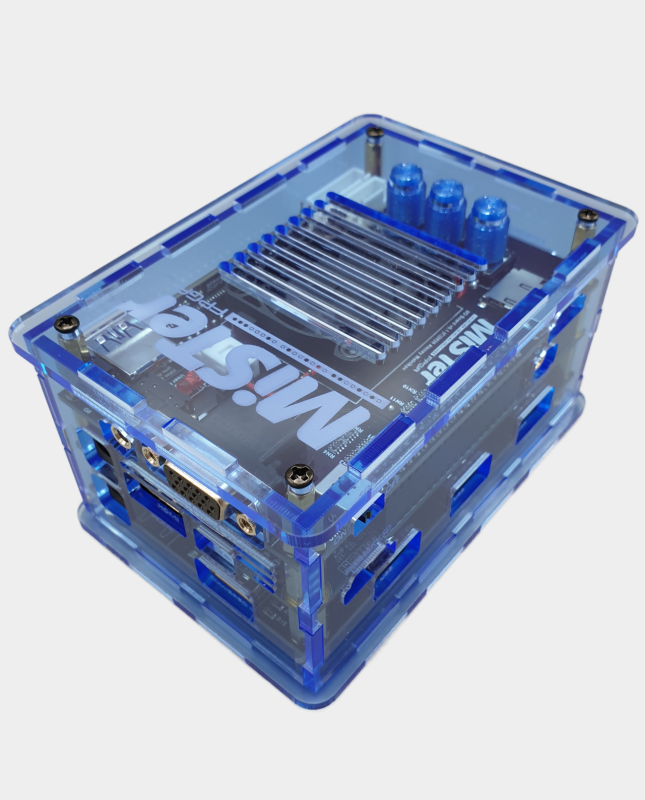
- MiSTer acrylic case — for DE10-Nano builds. Acrylic looks good and costs little, but it holds heat, so pair it with a heatsink at minimum and ideally a fan.
- MiSTer Pi acrylic case — cut for the MiSTer Pi outline, which differs from the DE10-Nano. Do not assume a DE10-Nano case will fit.
- BlisSTer acrylic case — for BlisSTer builds using the BlisSTer hub.
An acrylic case with no fan is the single most common cause of an overheating MiSTer. It is also the easiest problem to fix.
Protective plates and finishing touches
- Protective cover plates — cover exposed connectors and reduce dust ingress.
- External LED and button extensions — bring power indicators and reset buttons to the outside of a closed case.
These are refinements rather than essentials, but the LED extensions matter if you build into an enclosure where the board’s own indicators are hidden.
Recommended combinations
- Open build, low cost: heatsink only. Fine on an open bench with good room airflow.
- Open build, enclosed space: heatsink plus a fan. Handles warm rooms and long sessions.
- Acrylic case, DE10-Nano: copper heatsink plus fan, or the fan and heatsink kit.
- Acrylic case, no IO board: fan plate kit — it provides the mounting plate and the cooling in one.
- CRT and SNAC setup: IO board with A/V output plus a fan on the header, inside a case with ventilation.
What to avoid
- Enclosing the board with no heatsink at all.
- Running a fan from an unverified GPIO pin or voltage.
- Buying a case for one board and expecting it to fit another.
- Assuming a crash is a software problem before checking temperature and power.
Frequently asked questions
Do I need a case at all?
No. It protects the board and looks tidier, but cooling matters more.
Is a copper heatsink worth the extra?
In hot rooms or enclosed cases, yes. In an open build with airflow, a good aluminium heatsink is usually enough.
Will a DE10-Nano case fit a MiSTer Pi?
No. The board outlines differ. Buy the case cut for your board.
Do I need a fan if I use an acrylic case?
Strongly recommended. Acrylic retains heat and gives airflow nowhere to go.
Shop the ranges: browse cases and cooling.
Related reading
Still deciding on part of your build? These guides cover the other choices MiSTer owners face most often.
- MiSTer cooling and power guide — heatsinks, fans and safe fan wiring in detail.
- MiSTer FPGA starter kit UK — how cooling fits into a first build.
- DE10-Nano vs MiSTer Pi vs QMTECH — which cases fit which board.
- MiSTer FPGA power supply: what specs you need — the other half of build stability.
