Guides
DE10-Nano vs MiSTer Pi vs QMTECH: Which to Buy?
Sep
There are now three realistic ways into MiSTer FPGA, and they are not equally suited to everyone. The Terasic DE10-Nano is the board MiSTer was built on. The Retro Remake MiSTer Pi and QMTECH Cyclone V boards are cheaper, more available alternatives that run the same cores. This comparison covers what actually differs.
Why the choice matters less than you think
All three boards carry a Cyclone V SoC — an ARM processor alongside FPGA fabric. MiSTer’s menu, cores and updates run identically on all of them. The differences are physical: price, power input, cooling, available IO and how easily accessories attach.
DE10-Nano: the reference platform
The DE10-Nano comes from Terasic and is the board the whole MiSTer ecosystem was designed around. Every IO board, case and adapter has been tested against it.
- Strengths: widest accessory support, documented power and GPIO layout, the standard against which every guide is written.
- Weaknesses: the most expensive option, availability in the UK varies, stock is often limited.
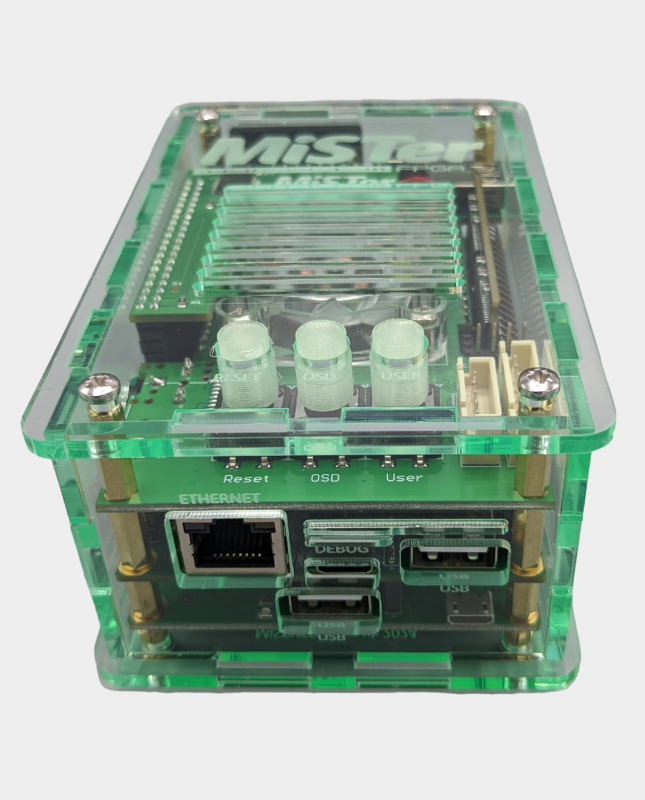
If you want a build that matches instructions exactly and you do not mind paying for that certainty, this is the safe choice. It pairs with the Digital IO Board or IO Board A/V Pro and a DE10-Nano acrylic case.
MiSTer Pi: the value option
Retro Remake’s MiSTer Pi exists to make MiSTer cheaper. It runs the same cores and has become popular enough that a full accessory ecosystem has grown up around it.
- Strengths: lower cost, frequently in stock, clean layout, designed for MiSTer from the outset.
- Weaknesses: powered over USB-C rather than a barrel jack, so a DE10-Nano power supply needs an adapter; some DE10-Nano cases and accessories do not fit.
For USB-C power, use the DC to USB-C adapter with a 5V 4A supply. A dedicated MiSTer Pi acrylic case is available for the different board outline.
QMTECH Cyclone V: the third path
QMTECH boards use the same Cyclone V SoC in a different physical layout. They are often the cheapest route to a working MiSTer.
- Strengths: low cost, readily available, runs standard MiSTer cores.
- Weaknesses: board revisions differ; some accessories and heatsinks are not compatible; you usually need to confirm the exact revision before buying add-ons.
Check cooling compatibility carefully. The acrylic fan plate kit is not compatible with QMTECH boards, while a simple heatsink generally is.
Side-by-side summary
- Lowest cost: QMTECH Cyclone V.
- Best balance of cost and ecosystem: MiSTer Pi.
- Most compatible and best documented: DE10-Nano.
All three run the same SDRAM modules and the same controller options. See our MiSTer Pi vs DE10-Nano comparison for a focused look at the two most common choices.
Power and cooling differences
Power input is the most practical difference. The DE10-Nano takes a DC barrel jack; MiSTer Pi takes USB-C; QMTECH revisions vary. That affects which supply you buy and whether you need an adapter.
Cooling is similar across all three — the Cyclone V runs warm regardless of board. A solid copper heatsink or a quiet fan is worthwhile on any of them. The full picture is in the cooling and power guide.
Which should you buy?
Buy a DE10-Nano if you want zero surprises and full accessory compatibility. Buy a MiSTer Pi if you want the most sensible cost-to-support ratio. Buy QMTECH if budget is the priority and you are willing to verify compatibility before ordering add-ons. Whichever you choose, budget for SDRAM, cooling and a proper power supply — those are not optional.
Frequently asked questions
Do MiSTer cores work on all three boards?
Yes. Cores target the Cyclone V SoC, which all three boards use.
Can I use the same IO board on every board?
Not always. DE10-Nano IO boards are the reference design; MiSTer Pi has its own compatible options, and QMTECH boards vary by revision. Confirm before ordering.
Is MiSTer Pi lower quality?
No. It is a different physical design built for the same purpose. The cores are identical.
Which is easiest to power?
The DE10-Nano, because it uses a standard barrel jack with a well-documented 5V requirement.
Compare the parts: see our expansion boards and cases ranges.
Related reading
Still deciding on part of your build? These guides cover the other choices MiSTer owners face most often.
- MiSTer FPGA starter kit UK — the full list of parts a first build actually needs.
- The cheapest way to build a MiSTer in the UK — how the board choice affects the total.
- MiSTer cooling and power guide — the requirements that apply to every board.
- How to set up MiSTer FPGA — from a blank SD card to your first game.
